

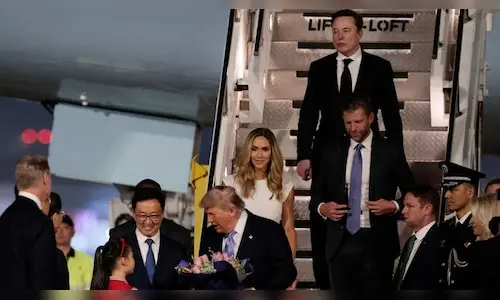
In a bold move that has raised eyebrows in legal circles, Elon Musk flew to China alongside U.S. President Donald Trump for a three-day state visit from May 13 to 15, despite being placed on 'recall status' by a federal judge overseeing his $150 billion lawsuit against OpenAI. The judge, Yvonne Gonzalez Rogers, had explicitly told Musk during a court appearance on April 30 that he was 'not excused' from further testimony, yet the Tesla and SpaceX CEO reportedly left the country without seeking the court's permission.
The lawsuit, filed in California, accuses OpenAI and its co-founders Sam Altman and Greg Brockman of abandoning their original nonprofit mission to develop artificial intelligence for the benefit of humanity, instead becoming a for-profit entity heavily backed by Microsoft. Musk, who was an early investor and co-chair of OpenAI before stepping away, claims the company has strayed into dangerous territory, prioritizing commercial gains over safety. He is seeking approximately $150 billion in damages to be paid to an OpenAI nonprofit, as well as the removal of Altman and Brockman from their leadership roles.
The trial has been closely watched by the tech industry, with Musk portraying himself as a guardian of the public interest against the unchecked ambitions of Silicon Valley. His legal team had asked the court to excuse him from further attendance, but the judge declined, placing him on recall—a status that means he could be summoned back to the witness stand at any moment. Legal experts note that recall status does not physically restrict a party, but it is expected that the individual remains within the court's jurisdiction or at least obtains approval before traveling abroad.
Professor Jeffrey Bellin of Vanderbilt Law School commented, 'If I were the attorney, I would have made sure that if my witness is subject to recall and he's left the country, that the judge is OK with that.' However, sources indicate that Musk's legal team did not inform the court about the planned international trip. The judge's instructions were clear: 'Mr. Musk, you are not excused, but you can leave for the day.' Musk apparently interpreted the phrase as permission to leave indefinitely, ignoring the explicit qualifier.
The timing of the trip is particularly noteworthy as the trial was in its final stages. The last day of evidence was scheduled for Wednesday, with closing arguments set for Thursday, and a jury verdict expected as early as the following week. By Friday, it became clear that Musk had not been recalled, and the practical risk passed without incident. Yet the episode has highlighted the tensions between the high-profile defendant and the judicial system.
This is not the first time Musk has courted controversy with his legal obligations. In 2018, he settled with the SEC after tweeting about taking Tesla private, a move that resulted in a $20 million fine and his temporary removal as chairman. His combative relationship with regulators and courts has become a hallmark of his leadership style. Meanwhile, his alliance with President Trump, whom he has advised on technology and business matters, adds another layer of complexity. Trump's own history of legal challenges and his willingness to challenge judicial authority may have emboldened Musk.
The underlying lawsuit against OpenAI stems from Musk's belief that the organization has become a threat to global safety. OpenAI initially launched as a nonprofit with a pledge to develop AGI (artificial general intelligence) responsibly and share its benefits widely. But after Musk left the board in 2018, the company transitioned to a 'capped profit' model, later restructuring to attract massive investments from Microsoft. Musk argues that this shift violated the original charter and has led to reckless development of AI without adequate safeguards. OpenAI counters that its structure allows it to raise necessary capital while still adhering to its mission, and that Musk's lawsuit is an attempt to disrupt a competitor.
The trial has featured testimony from leading AI researchers, including Sam Altman, who defended OpenAI's track record. Altman stated that the company has invested heavily in safety research and that its products, such as GPT-4 and DALL-E, are deployed with extensive mitigation measures. Musk's own testimony highlighted his fears: he warned that unregulated AI could lead to catastrophic outcomes, including the spread of disinformation, job displacement, and even autonomous weapons. He pointed to the rapid pace of AI development and the lack of international governance as reasons for urgent action.
Musk's trip to China with Trump was not purely personal. The presidential visit involved high-level talks on trade, technology, and geopolitical issues. For Musk, it was an opportunity to discuss Tesla's expansion in China, where the company operates a massive Gigafactory in Shanghai. China is a critical market for electric vehicles, and Musk has cultivated relationships with Chinese officials. His presence alongside Trump could strengthen his standing with Beijing while also signaling his close ties to the White House. However, critics argue that his simultaneous courtroom obligations should have taken precedence.
Legal analysts suggest that while Musk's departure was risky, the chance of being recalled during those specific days was low, as the trial was winding down. Still, the incident underscores the challenges of enforcing court orders against ultra-wealthy individuals who have the resources to travel freely. 'In theory, the judge could have issued a bench warrant or sanctioned Musk, but that would have been a dramatic escalation given the circumstances,' said Professor Bellin. Typically, attorneys negotiate such matters discreetly to avoid public confrontations.
The broader implications of the trial extend beyond Musk and OpenAI. If Musk succeeds in his bid to restructure OpenAI or secure damages, it could set a precedent for how AI companies are held accountable to their founding promises. Conversely, a defeat for Musk could embolden other tech giants to pursue profit-driven AI development without fear of legal repercussions. The jury's decision, expected soon, will be a landmark in the evolving relationship between technology, ethics, and the law.
As the world watches the closing arguments, Musk remains in China, likely following the proceedings remotely. His attorneys have assured the court that he is available via video conference if needed. The judge has not yet commented on the apparent violation, but the incident has already become a talking point in legal blogs and tech media. For now, Musk's dual roles as a litigant and a presidential advisor have collided in spectacular fashion, raising questions about accountability at the highest levels of power.
Source: CNBCTV18 News