

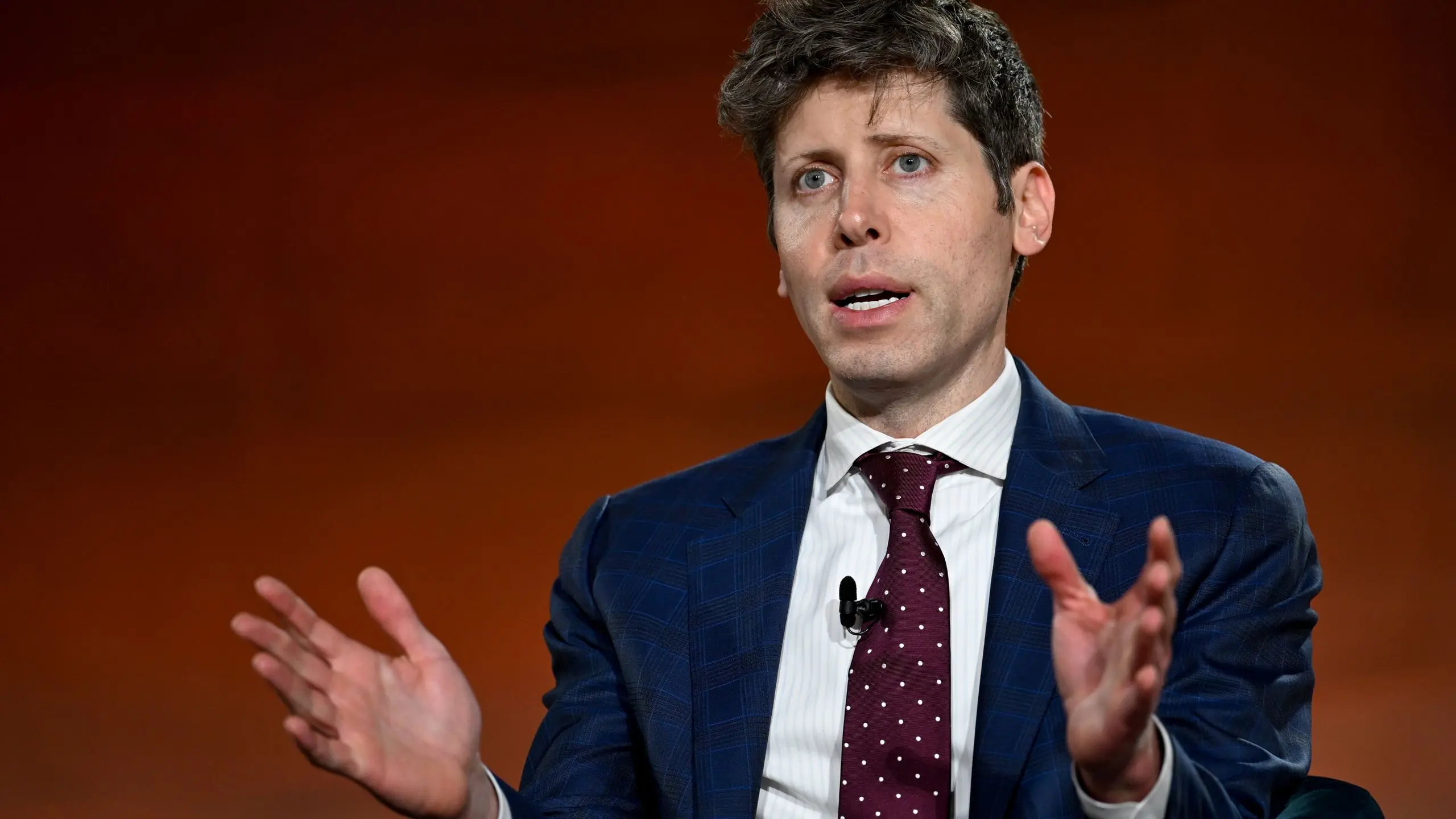
Sam Altman, the chief executive officer of OpenAI, has laid out a compelling vision for what he calls the company's 'third phase' of development, a strategic shift that moves beyond the initial research-focused era and the subsequent product-launch stage. In a detailed statement shared with employees and later made public, Altman clarified that the future of artificial intelligence should not be about replacing humans but about enhancing human potential. 'Entirely automating everything is not the future we want,' Altman said, directly addressing concerns that AI could lead to widespread job displacement and loss of human agency.
The new phase, according to Altman, will concentrate on building technology 'to benefit everyone,' a phrase that signals a renewed commitment to ethical AI development and inclusive growth. This marks a significant departure from the earlier narrative that often focused on the race to achieve artificial general intelligence (AGI) at any cost. Instead, OpenAI now seeks to embed its systems in ways that complement human work, creativity, and decision-making.
Background: The Evolution of OpenAI
OpenAI was founded in 2015 as a non-profit research organization with the goal of ensuring that AGI 'benefits all of humanity.' Over the years, the company has gone through several transformations. The first phase, approximately from 2015 to 2019, was characterized by fundamental research, publishing papers, and developing early AI models like GPT-1 and GPT-2. The second phase, starting around 2020 with the launch of GPT-3 and later ChatGPT, focused on productizing research, scaling models, and capturing commercial opportunities. This phase saw explosive growth—ChatGPT became the fastest-growing consumer application in history, and OpenAI evolved into a capped-profit company, attracting massive investment from Microsoft.
However, this rapid commercialization also brought criticism. Concerns about job displacement, bias, misinformation, and the centralization of power in a handful of tech giants intensified. Altman himself acknowledged these issues in his latest statement, noting that the company had learned valuable lessons about the societal impact of its technology.
The Third Phase: Human-Centric AI
Altman outlined that the third phase will place 'human agency and empowerment' at the core. Instead of building systems that automate tasks from start to finish, OpenAI will focus on developing tools that assist humans in being more productive, creative, and informed. This includes enhancing existing products like ChatGPT with better collaboration features, improving reasoning capabilities while maintaining transparency, and investing in AI literacy programs.
One key initiative is the creation of 'AI co-pilots' for various professions—doctors, lawyers, engineers, artists, and teachers—that augment rather than replace their expertise. Altman cited examples: an AI that helps a surgeon analyze medical images faster, a writing assistant that helps journalists research and draft articles without generating falsehoods, and a coding assistant that helps programmers debug and optimize code rather than writing it entirely.
Another pillar of the third phase is safety and alignment research. OpenAI plans to allocate more resources to red-teaming, interpretability, and guardrails that prevent misuse. Altman emphasized that 'building AGI that is aligned with human values is the hardest technical challenge of our time,' and that the company's progress in this area must be shared openly with the research community.
Addressing Economic and Social Fears
The CEO directly addressed the widespread fear that AI will lead to mass unemployment. He argued that while automation will certainly disrupt certain jobs, the goal should be to 're-skill and redeploy' rather than replace human workers. OpenAI is reportedly exploring partnerships with educational institutions and workforce training programs to help people adapt to the changing economy. Altman also floated the idea of 'universal basic compute'—ensuring that everyone has access to powerful AI tools—as a way to democratize the benefits of the technology.
This stance aligns with Altman's earlier writings, including his essays on 'Moore's Law for Everything,' where he argued that AI could drive an economic revolution similar to the industrial revolution, but that society needed to redistribute the gains to avoid catastrophic inequality.
Past Controversies and Lessons Learned
OpenAI's journey has not been without controversy. In late 2023, Altman was briefly ousted by the board of directors, only to be reinstated after a dramatic few days of negotiations. The incident highlighted governance tensions within the company, particularly between those advocating for cautious, safety-first development and those pushing for faster commercialization. Altman's return and subsequent restructuring signaled a compromise: faster deployment but with stronger oversight and accountability.
Another major controversy was the release of ChatGPT without robust content filters, leading to the generation of harmful or misleading outputs. OpenAI has since improved its moderation systems, but the incident underscored the challenges of deploying powerful AI at scale. Altman acknowledged these failures during his statement, saying that the third phase would be 'more deliberate about launch decisions.'
Furthermore, the company faced criticism for its closed-source approach to GPT-4, contrasting with the open ethos of earlier models. Under the new vision, OpenAI may adopt a hybrid model—keeping some core technology proprietary for safety and competitive reasons but open-sourcing other components to foster wider academic research and independent auditing.
Competitive Landscape and Industry Reaction
OpenAI's pivot to a human-centric approach comes amid intense competition from companies like Google (with Gemini), Anthropic (with Claude), Meta (with Llama), and numerous startups. Anthropic, in particular, has positioned itself as a safety-focused alternative. However, Altman believes that OpenAI's scale, talent, and infrastructure give it a unique advantage in building AI that is both powerful and aligned.
The industry reaction has been mixed. Some researchers praised the move, saying it addresses the 'alignment problem' more realistically than chasing AGI supremacy. Others remain skeptical, pointing out that OpenAI still operates as a for-profit entity and may prioritize revenue over human well-being. Altman countered by stating that the capped-profit structure ensures any profits beyond a threshold are reinvested into research, and that the company's mission remains at the core.
Technological Challenges Ahead
Achieving the vision of human-centric AI is technically difficult. Current AI systems still suffer from hallucinations—generating plausible but incorrect information—and lack robust common sense reasoning. OpenAI is researching new architectures, including more efficient transformer models, multimodal systems that can seamlessly handle text, images, and video, and new training paradigms like reinforcement learning from human feedback (RLHF) combined with constitutional AI principles.
Altman also hinted at 'agentic' systems that can perform complex tasks over multiple steps but with heavy human supervision. These agents, he said, would not act autonomously in the world but would be assistants that require user confirmation at each critical juncture. This cautious approach is intended to prevent the 'runaway AI' scenarios that alarm many tech ethicists.
Open Source and Collaboration
Another cornerstone of the third phase is increased collaboration with external researchers and policymakers. OpenAI has already established a 'Preparedness' team to evaluate catastrophic risks, but Altman wants to expand these efforts. He proposed creating an international body to set AI safety standards, modeled partly on the International Atomic Energy Agency (IAEA) but adapted for AI.
This call for regulation is strategically timed. Governments worldwide are scrambling to draft AI laws—the EU AI Act is a prime example, and the US has issued an executive order on AI safety. By proactively engaging with regulators, OpenAI hopes to shape rules that are effective without stifling innovation. Altman has met with leaders in the US, Europe, and Asia to advocate for a balanced regulatory approach.
Critiques and Alternative Visions
Not everyone agrees with Altman's framing. Critics like Eliezer Yudkowsky and other AI safety advocates argue that any delay in solving alignment is dangerous, and that 'human-centric' AI is a distraction from the real risk of creating a superintelligence that does not share human goals. They warn that even with supervision, AGI could be manipulated or break out of its constraints.
On the other extreme, accelerationists like some entrepreneurs in Silicon Valley believe that full automation is inevitable and desirable, and that slowing down to focus on human augmentation is a mistake. Altman is navigating between these poles, trying to chart a middle path that satisfies both safety advocates and business goals.
Looking Ahead
OpenAI's 'third phase' is already underway. The company recently released GPT-4o, a multimodal model with improved voice and vision capabilities, and announced partnerships with healthcare and education providers. It also launched a new team dedicated to 'societal impact' that will study the long-term effects of AI on employment, democracy, and mental health.
Altman ended his statement by reiterating that the future of AI is not predetermined. 'We have a choice,' he said. 'We can build a world where machines do everything and humans become obsolete, or we can build a world where AI amplifies the best of human creativity, empathy, and resilience. That is the future we want.'
This ambitious vision will require tremendous effort, transparency, and luck. But for now, OpenAI has laid down a marker: the next chapter of artificial intelligence will be written with people, not just machines, at the center.
Source: TechRadar News