

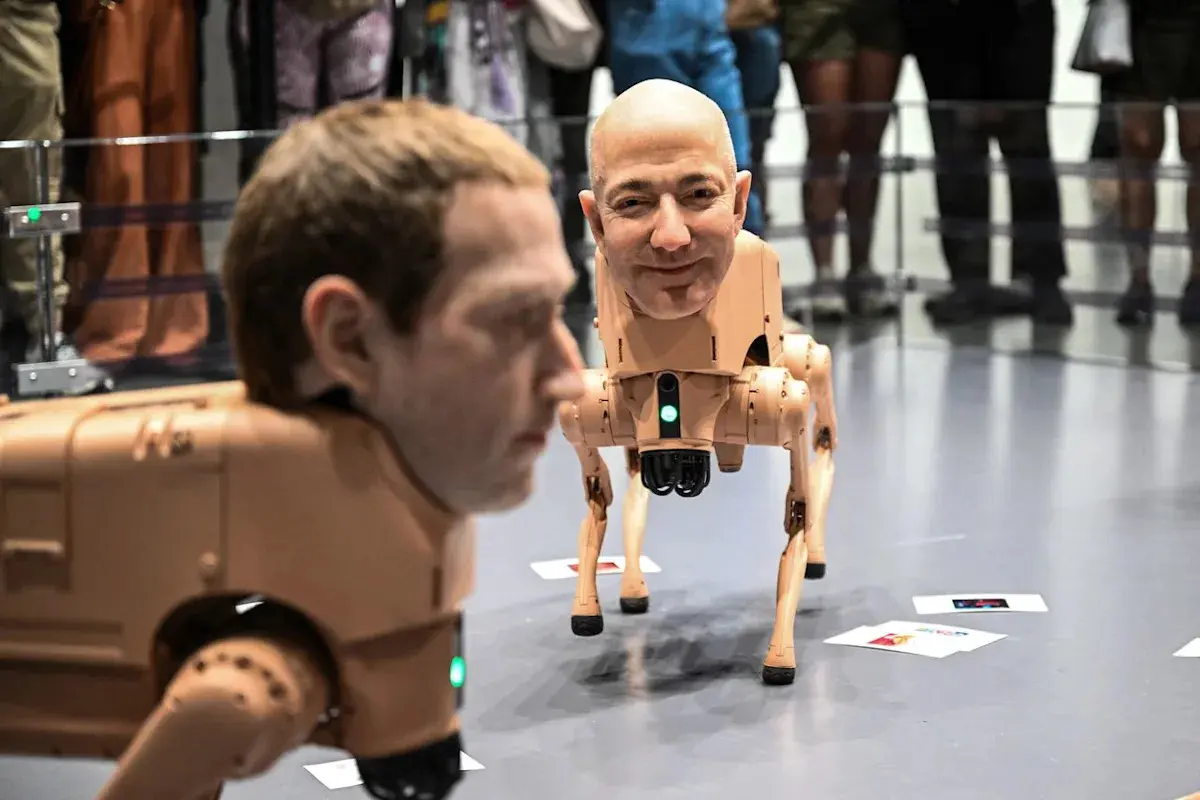
If you've not already seen videos of American artist Beeple (Mike Winkelmann)'s "Regular Animals" art piece, you're likely suffering from a severe lack of context and confusion at this headline. Two robot tech titans walk into an arena—or, more precisely, a series of robot dogs with hyper-realistic silicone heads of Elon Musk, Jeff Bezos, and Mark Zuckerberg wander through the marble halls of Berlin's Neue Nationalgalerie. They do not simply exist: they interact with the space and produce something both crude and thought-provoking.
The installation, currently housed at Berlin's Neue Nationalgalerie, features free-roaming robot dogs with hyper-realistic silicone heads, some of which are sculpted in the image of renowned tech figures such as Elon Musk, Jeff Bezos, and Mark Zuckerberg. Others depict famed artists like Pablo Picasso or Andy Warhol—all individuals with, in one way or another, unique perspectives on the world. It is that clash of perspectives that forms the backbone of Winkelmann's work, as the Unitree Go2 robot dogs will "poop" out printed images as they autonomously roam around the hall. These images are captured by integrated cameras and processed by AI, producing printouts that reflect each robodog persona's perspective.
Is it crude? Perhaps, but the installation and dark humor have certainly been a conversation starter in and out of the tech sphere. The juxtaposition of high-end robotics, customizable silicone masks, and AI-generated imagery creates a spectacle that is at once absurd and deeply unsettling. Beeple, whose real name is Mike Winkelmann, has built a career out of blending digital art with the most pressing cultural and technological currents of the day. From his long-running "Everydays" project—where he created a new digital artwork daily since 2007—to his pioneering role in the NFT art market, Beeple consistently pushes boundaries.
The Art of the Provocation
In this latest project of viral fame, Beeple poses a question that perhaps more of us should be asking: Should our worldview be governed by tech and the powerful figures who control it? It is an especially pertinent question in the post-AI world we live in, wherein lax regulations, extraordinary market disruption, and a race to the finish all converge, leaving in their wake a mess of questionable ethics and environmental impact. The robot dogs do not simply wander aimlessly; they are programmed to move around the gallery, pausing to capture images of visitors or the space itself. Those images are then fed through a customized AI model trained on the alleged perspective of the figure whose silicone head the dog wears. For example, a dog with a Zuckerberg mask might produce images filtered through a lens of social connection and data collection, while a Musk-headed dog might generate outputs focused on futurism and Mars colonization.
The results are printed on small rolls of paper and deposited on the gallery floor—a literal mess that the audience can pick up and examine. It is a performative critique of how tech billionaires shape our reality through their algorithms, often without transparency or accountability. In the age of social media, where algorithms decide what we see and when we see it, the power of a handful of individuals to reshape public discourse is unprecedented. Musk, Zuckerberg, Bezos, and others like Sam Altman have become the new gatekeepers of information, and their personal biases and business interests ripple through the platforms they own or influence.
Beeple's Provocative History
Beeple is no stranger to the juncture between tech and art. He has fronted movements like artwork-a-day trends with his long-running project Everydays, which has seen him create and publish a new digital artwork daily since 2007. His work also helped launch the art marketplace for NFTs, and even previously gave away the photos taken by his robot dogs to audience members during an earlier appearance at the Art Basel 2025 event, some of which included QR codes that gave access to free NFTs of Beeple's digital art. The "Regular Animals" installation builds on that legacy, taking it a step further into the physical world. The robot dogs are not just props; they are the performers, and their actions are both predictable and spontaneous, like the algorithms they mimic.
The choice of tech titans is deliberate. Musk, the CEO of Tesla and SpaceX, has been a vocal figure in AI development, from his co-founding of OpenAI to his xAI venture. Zuckerberg, the CEO of Meta, has invested heavily in artificial intelligence for social media, virtual reality, and the metaverse. Bezos, the founder of Amazon and Blue Origin, has poured billions into AI through Amazon Web Services and other ventures. These three men represent different facets of the tech world, yet they all share a certain level of influence that rivals governments. Beeple's installation forces viewers to confront the fact that these individuals—whoever is behind the silicone masks—are shaping our collective reality, often without explicit consent or civic debate.
The AI Perspective and the Algorithmic Overlords
Winkelmann told the Associated Press, "In the past, our view of the world was shaped in part by how artists saw the world. How Picasso painted changed how we saw the world, how Warhol talked about consumerism, pop culture, that changed how he saw those things." He continues, explaining that in today's climate, our collective worldview is shaped by billionaires in tech who control the narrative with powerful algorithms. "That's an immense amount of power that I don't think we've fully understood, especially because when they want to make a change, they don't need to lobby the U.N. They don't need to get something through Congress or the EU, they just wake up and change these algorithms."
That statement resonates deeply in a world where social media platforms alter their recommendation engines overnight, influencing elections, consumer behavior, and public opinion. The robot dogs, with their poop-shaped outputs, are a physical metaphor for the algorithmic slop that fills our digital feeds. The AI-generated images are not always coherent; they are often surreal, fragmented, and unsettling—much like the content produced by neural networks when left to their own devices. Beeple's work highlights the disconnect between the sleek, user-friendly interfaces of tech products and the messy, often opaque systems running behind the scenes.
The use of robot dogs themselves is also a commentary on the militarization and commercialization of robotics. The Unitree Go2 is a commercial quadruped robot, often used in industrial inspection, security, and even entertainment. By placing silicone heads on them, Beeple humanizes the machines but also exposes the absurdity of treating machines like human personalities. The dogs are not truly autonomous; they are programmed by humans, just as the algorithms that govern our digital lives are written by engineers in the employ of billionaires.
Public Reception and Cultural Impact
Whether or not you agree that the installation is "art" aside, it is a surprisingly poignant message for a project that consists of pricey robot dogs in uncannily accurate silicone masks pooping out AI slop. Visitors to the Neue Nationalgalerie have been both amused and disturbed by the spectacle. Some have picked up the printouts as souvenirs; others have criticized the piece as wasteful or superficial. But that is precisely the point: the installation generates conversation, and in doing so, it forces people to think critically about the role of big tech in their lives.
Beeple's work comes at a time when public consciousness around AI ethics is growing. The rapid deployment of generative AI tools like ChatGPT, Midjourney, and Grok has sparked debates about copyright, misinformation, and job displacement. At the same time, the personalities behind these tools—Sam Altman, Elon Musk, Mark Zuckerberg, and Jeff Bezos—have become household names, their choices subjected to intense scrutiny. The recent New Yorker profile on Sam Altman perfectly illustrates this: it delved into Altman's personal life, his management style, and his vision for AI, prompting a wave of commentary about whether we should care about the character of tech leaders.
In a recent episode of the TechRadar Podcast, my colleague Hamish Hector noted, "It plays into this bigger realization that these figures at the very top of the AI sphere, like Sam Altman for OpenAI, Elon Musk for Grok, and Mark Zuckerberg for Meta, that maybe we should be interested in what these people are like and how they behave." That is precisely the conversation Beeple is trying to start. By placing the faces of the titans on robot dogs that produce art, he is asking who is really in control—and whether that control is a good thing.
The Broader Canvas of AI Art and Society
The installation also fits into a larger trend of AI-generated art challenging traditional notions of creativity and authorship. Beeple himself made headlines in 2021 when his NFT artwork "Everydays: The First 5000 Days" sold for $69 million at Christie's. Since then, the NFT market has experienced wild ups and downs, but Beeple has remained a consistent voice in the digital art world. His work often explores the intersection of technology, commerce, and pop culture, and "Regular Animals" is no different. The robot dogs are both the medium and the message—they are tools of the tech industry, repurposed to critique it.
Looking ahead, Beeple has hinted that the installation may evolve with new masks and algorithms as the exhibition runs. The Neue Nationalgalerie has not disclosed the exact duration, but the piece is expected to remain on display for several months. In the meantime, the robot dogs will continue to roam, capturing images, processing them through AI, and leaving their printed turds for the public to ponder. It is a fitting metaphor for the digital age: we are constantly bombarded with content generated by algorithms controlled by a few powerful individuals, and the output is often messy, unpredictable, and inscrutable.
Whether one admires Beeple's nerve or finds the piece distasteful, it is undeniable that "Regular Animals" has succeeded in provoking conversation. The robot dogs have become a viral sensation on social media, with videos of them defecating AI prints garnering millions of views. The controversy is itself part of the art, a feedback loop that mirrors the very systems Beeple critiques. In a world where attention is the ultimate currency, even the most absurd installation can serve as a mirror for our collective anxieties about technology and power.
Source: Yahoo Entertainment News