

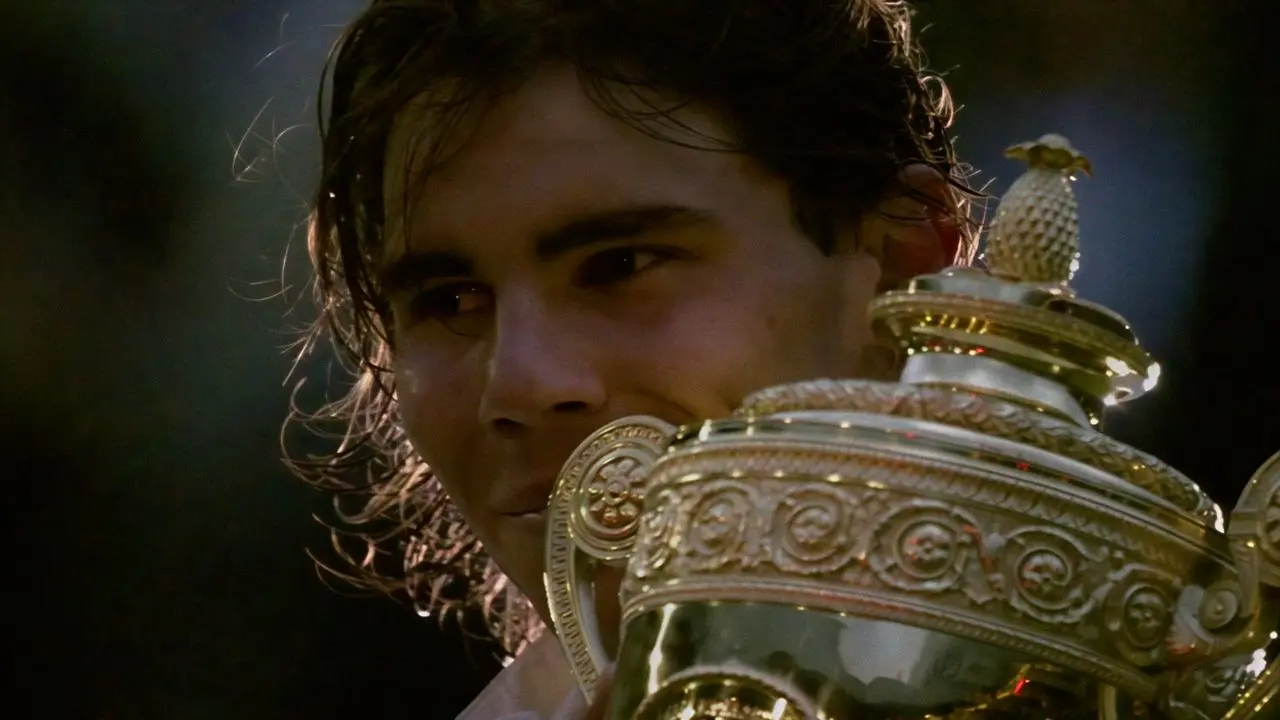
When the legendary Rafael Nadal retired at the end of 2024 at the age of 38, he seemed to take with him not just his 22 Grand Slam titles—a record 14 of them at the French Open—but an entire world of secrets, too. Unlike many other athletes who played a sport at the highest level for a long period, Nadal didn’t seem to care to unburden his soul. Unfailingly polite, revered by his rivals, and one of the greatest sportsmen to ever play tennis, Nadal was also, as a man of few words, eternally something of a cipher.
Director Zach Heinzerling’s new four-part documentary, Rafa, which premieres on Netflix on May 29, goes a long way to change all that. We see Nadal grow up in Majorca, a tennis prodigy from an early age, coached and shaped—for almost the entirety of his career, as it turned out—by his uncle Toni, who taught him to push and push and push. Crucially, though, we also see the toll of this pushing on Nadal’s body as well as his psyche.
Lifelong Rafa-watchers are well aware of the injuries that far too often kept Nadal from playing tournaments. Over the course of his career, he missed 18 Grand Slams. But even the most devoted fans were taken aback when watching Rafa at how early these injuries started—how serious and rather existential they were, and how early and often Nadal was forced to make excruciating choices about his health and his career.
The documentary, replete with revealing conversations with Nadal himself, his uncle Toni, and with Roger Federer and Novak Djokovic, among many others, also delivers incredible insight into Nadal’s renowned on-court rituals, his almost Sisyphus-like drive, his tender relationship with his family, and his crucial decision-making about ending his career. In short: if you’re a tennis fan, or particularly a Nadal fan, this documentary is required watching. We caught up with Rafa over a Zoom to ask him about it.
An Exclusive Interview: Behind the Scenes of 'Rafa'
During the interview, Nadal spoke candidly about his motivations for doing the documentary. “Because it’s something that is going to stay forever with us. I think it’s going to be a good memory of the last stages of my tennis career—in a personal way. And then I found the right team: great director, Zach Heinzerling, and a great team working on it. It’s something I refused to do during my tennis career, but this time I decided to move forward with it, during the last year of my career, knowing that it probably was my last chance.”
When asked whether any moments were off-limits, Nadal laughed: “I mean, when I’m going to the shower, I don’t want them to show my shower time! No—but I mean, if you do a documentary like this, you have to do it the proper way. If not, don’t do it. I didn’t want to hide anything—I was just being myself.”
The documentary reveals Nadal’s famous on-court rituals—adjusting his hair, headband, shorts, and aligning water bottles at changeovers. Uncle Toni revealed that Nadal once tried to stop these habits but couldn’t. Rafa explained: “People probably think that I was doing all of this because I am superstitious, but I am really not—and I am not doing any of this stuff in my real life. It was a way to make myself comfortable, a way to get myself focused on what I was doing, and a way of not distracting my mind from what I was doing in every moment. The rituals helped me to know exactly what I was doing when I was on court. And of course those rituals were increasing during my tennis career—at the beginning, I had less; later on, I had more. But in some way, when you have to compete every day against an opponent, you need to be in your bubble. And that was the way that I felt comfortable.”
The Price of Greatness: Playing Through Pain
One of the most riveting parts of the documentary is the focus on Nadal’s decision-making about his health. He made critical choices early in his career and throughout—often against medical advice. Asked if he now regrets playing through pain, Nadal reflected: “Of course I would change decisions that I made in my life—without a doubt. But it’s easy to say now, after knowing the result. On the other hand, because I was able to explore where the limit was, I was able to have a much longer career, and I was able to achieve much more than if I hadn’t tried. So I would change things, yes—but with all the things that I did in my tennis career, I was thinking that I was doing the best thing possible to keep playing tennis at the highest level.”
The documentary underscores just how many setbacks Nadal faced—starting with a foot condition at age 19 that nearly ended his career before it truly began, followed by chronic knee problems, wrist issues, and abdominal tears. His ability to bounce back, time and again, became a hallmark of his legend.
Life After Tennis: No Nostalgia
When asked whether he misses the intensity of the French Open, Nadal was unequivocal: “No—not at all. No. My life as a tennis player is closed, and well-closed. I’m very happy with my new life, and I don’t feel nostalgic about my past. I am very proud, but it’s over, and I’m happy with my new life.”
He then offered a prediction for the upcoming French Open: “That’s the great thing about sports: it’s unpredictable. It looks like Jannik Sinner is a huge favorite—he’s achieving everything—but it’s always difficult to win. But let’s see if he’s able to go all the way.”
The documentary provides an intimate look at Nadal’s final year, including his emotional farewell at the Davis Cup and the quiet moments with his wife and young son. It also includes interviews with key figures in his life, such as his parents, his longtime physiotherapist, and the coaches who helped shape him.
A Legacy Beyond Trophies
Nadal’s legacy extends far beyond his 22 Grand Slams. He is remembered as much for his sportsmanship and humility as for his relentless competitive fire. The documentary Rafa captures both sides—the warrior on court and the gentle family man off it. Just one day before his final professional match, he was seen playing with his son in the hotel hallway. Those personal moments, combined with the high-stakes tennis drama, make the series a must-watch for sports fans everywhere.
The four-part series premieres on Netflix on May 29, 2025. Whether you are a lifelong fan or a newcomer to tennis, Rafa offers a profound portrait of an athlete who pushed his body to its limits and emerged as one of the most beloved champions in history.
Source: Vogue News