

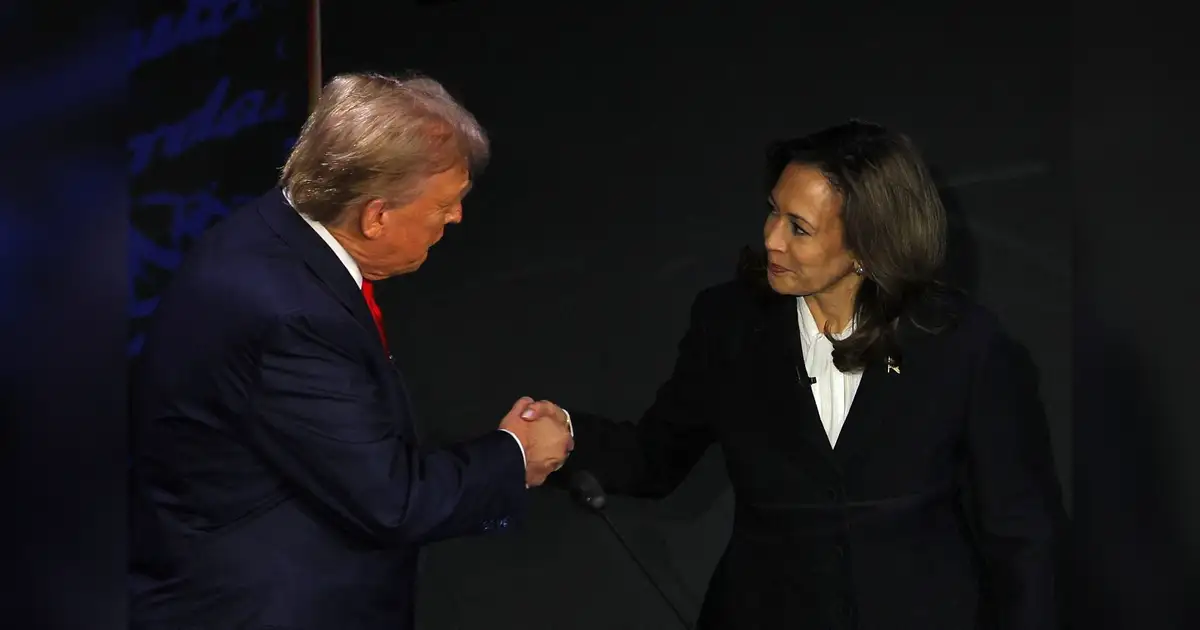
Democratic Vice-President Kamala Harris has expanded her lead over Republican Donald Trump in the race for the White House, now standing at 47% to 40% among registered voters, according to a new Reuters/Ipsos poll published on Tuesday. The three-day survey, which closed on Monday, shows Harris with a 7-point advantage—up from a 5-point lead in the previous Reuters/Ipsos poll taken September 11-12.
The unrounded figures reveal even greater detail: Harris garnered 46.61% support among registered voters, while Trump received 40.48%, a difference of 6.13 percentage points. The poll's margin of error is approximately 4 percentage points, meaning the lead is statistically significant. Among the 785 likely voters identified in the survey, Harris leads 50% to 44%, though the unrounded advantage again narrows to about 5 points.
Perhaps the most striking finding is the narrowing of Trump's edge on economic issues. When voters were asked which candidate has the better approach on the "economy, unemployment and jobs," 43% chose Trump and 41% picked Harris—a 2-point gap. This contrasts sharply with Trump's 11-point lead on the same question in late July, shortly after Harris launched her campaign, and his 3-point lead in an August poll. Earlier this year, before President Joe Biden withdrew from the race, Trump led Biden on the economy by 5 to 8 points in Reuters/Ipsos polling. The shift suggests Harris is chipping away at one of Trump's core strengths.
The economy remains the top issue for voters, and both candidates have intensified their economic messaging. Trump on Tuesday proposed creating special manufacturing zones on federal lands and reiterated his pledge to raise tariffs on imported goods. Harris has outlined tax breaks for families with children and higher taxes for corporations; she is expected to unveil additional economic proposals this week, though some advisers acknowledge time is running short to convince voters with policy details.
While national surveys like this provide a broad snapshot, the presidential election will ultimately be decided by the Electoral College, with seven battleground states likely to be pivotal. Recent polls in those states show a tight race, with many results within margins of error. A New York Times/Siena College poll, for example, found Trump with marginal leads in Arizona, Georgia, and North Carolina. The Reuters/Ipsos national lead for Harris, however, reflects a shifting landscape since she replaced Biden as the Democratic nominee following Biden's poor debate performance against Trump in June. At that time, Trump was widely seen as the frontrunner, buoyed by perceptions of his economic stewardship during a period of high inflation under the Biden administration.
Yet Trump's advantage on the economy is not monolithic. A separate Reuters/Ipsos poll in August asked about the "US economy" broadly—without specific reference to jobs or unemployment—and Trump led by 11 points (45% to 36%). The more recent poll, which specifies "economy, unemployment and jobs," shows a much closer contest, suggesting that when job creation is included, Harris gains ground. This nuance underscores the complexity of voter sentiment in an election where inflation has cooled but prices remain elevated.
The poll surveyed 1,029 U.S. adults online nationwide, including 871 registered voters. Among likely voters, the sample was 785. The data come as the FiveThirtyEight.com polling average shows a competitive national race, with Harris leading Trump 48.3% to 45.8%. The Reuters/Ipsos poll was conducted Sept. 21-23, closing just before the latest round of campaign events and policy announcements.
Harris entered the race with momentum after replacing Biden, whose candidacy faltered amid internal Democratic concerns about his age and electability. Her campaign has sought to define her as a moderate alternative to Trump, emphasizing economic equity, abortion rights, and democracy. On the economy, she has positioned herself as a defender of the middle class, while Trump continues to hammer his message of tariffs and protectionism, accusing Harris of supporting policies that would raise costs for consumers.
The race is entering its final stretch, with just over six weeks until Election Day. Both campaigns are pouring resources into television ads and ground operations in the battleground states. While the national polls shift gradually, the state-level dynamics remain critical. Harris's improved standing on economic issues could help her in states like Michigan and Pennsylvania, where blue-collar voters have been a key Trump constituency. Trump, meanwhile, is counting on strong turnout among his base and a slight edge in the Electoral College map to offset any national deficit.
Historically, candidates who trail in national polls at this stage can still win the Electoral College—as Trump did in 2016 when he lost the popular vote but won key states by narrow margins. The current polling averages and the Reuters/Ipsos data suggest that while Harris has an advantage, the race remains fluid. Voters' enthusiasm and the effectiveness of each candidate's closing message will likely determine the outcome in a deeply polarized nation.
Source: Khaleej Times News